Guide · Aug 11, 2026
How Do Noise-Canceling Headphones Work?
Discover how noise-canceling headphones work through the science of phase inversion, destructive interference, and active signal processing to eliminate ambient background sound.
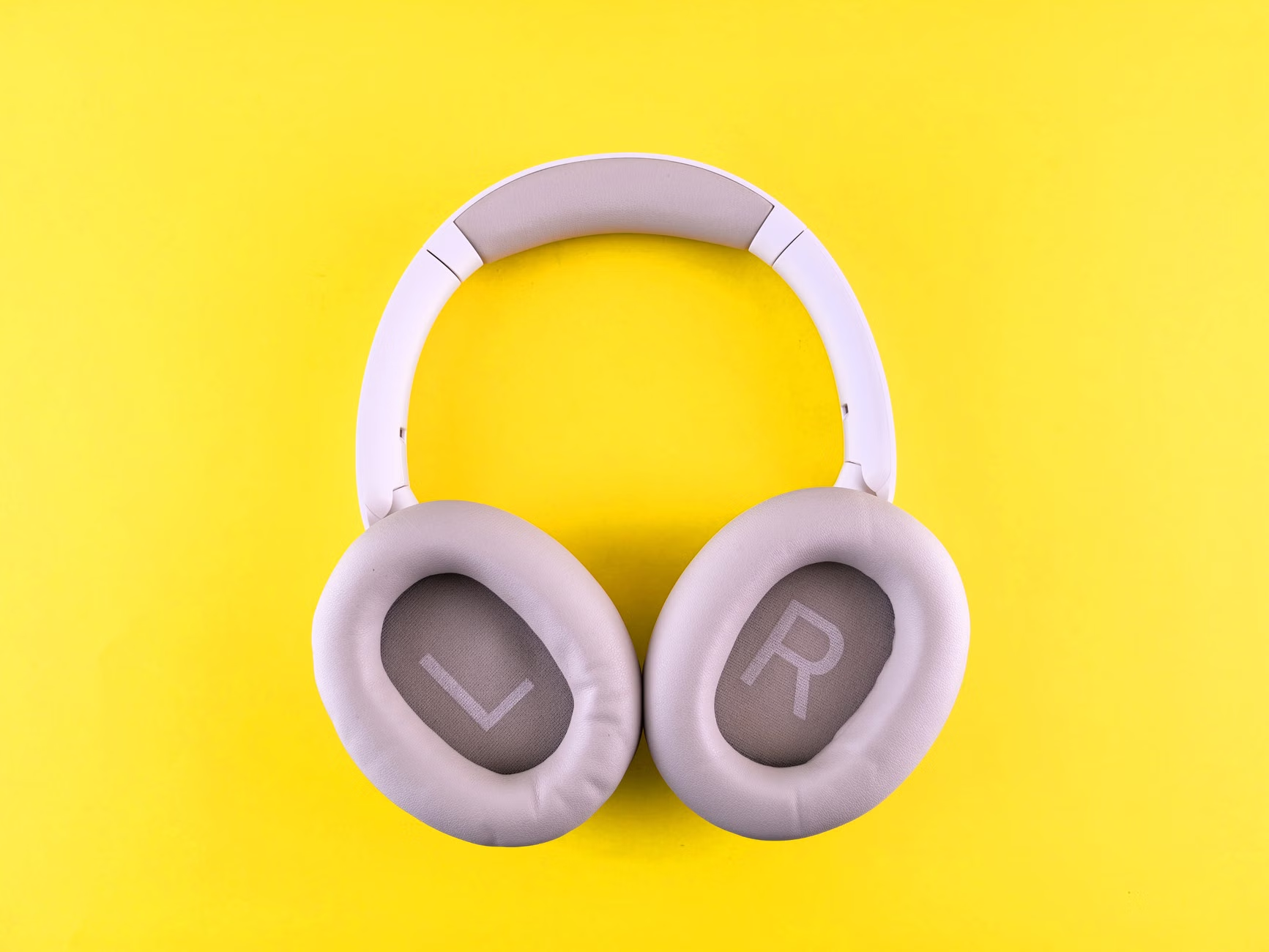
Whether you are sitting on a turbulent long-haul flight, trying to focus in a bustling coffee shop, or navigating a noisy city commute, slip on a pair of modern active noise-canceling headphones, and the background roar instantly fades into near silence. But how do noise-canceling headphones work behind the scenes? What feels like black magic is actually a sophisticated combination of sound physics, advanced acoustic engineering, and rapid digital signal processing.
To understand how noise-canceling headphones work, you must look at how sound travels through the air as energy waves. By capturing incoming noise in real time and creating an exact mathematical counter-wave, these devices neutralize ambient sound before it ever reaches your eardrums. In this comprehensive technical guide, we will break down the science of phase inversion, compare active and passive isolation, explore different internal microphone configurations, and examine why certain sounds are easier to cancel than others.
The Physics of Sound: Understanding Destructive Interference
At its core, active noise cancellation relies on a fundamental principle of acoustic physics called phase inversion, which leads to destructive interference. To understand this concept, it helps to first examine how sound travels through our environment.
Sound travels through air as pressure waves, consisting of alternating high-pressure peaks (compressions) and low-pressure troughs (rarefactions). When these pressure fluctuations hit your eardrum, your brain translates them into recognizable audio, such as an airplane engine, traffic, or human speech.
Sound Waves and Phase Alignment
When two sound waves meet, their pressure states combine. If two identical sound waves travel together in phase—meaning their peaks align with peaks and troughs align with troughs—they combine to create a wave with twice the amplitude (volume). This phenomenon is known as constructive interference.
The Science of Anti-Noise (180-Degree Phase Inversion)
Destructive interference happens when two identical sound waves meet completely out of phase—specifically, 180 degrees out of phase. In this state, the peak of one sound wave occurs at the exact same millisecond as the trough of another wave. The high pressure cancels out the low pressure, effectively reducing the net change in air pressure to zero. Because there is no change in air pressure hitting your eardrum, you perceive absolute silence. Noise-canceling headphones synthesize this matching opposite wave, commonly referred to as anti-noise.
How Active Noise Cancellation (ANC) Works Step-by-Step
Understanding how noise-canceling headphones work in real-time scenarios requires following the audio signal through its ultra-fast processing pipeline. Active Noise Cancellation (ANC) systems perform complex calculations in fractions of a millisecond to cancel ambient sound dynamically.
Step 1: Sound Detection via External Microphones
Miniature external-facing microphones built into the earcups constantly sample the ambient sounds in your surrounding environment, such as the drone of a jet engine or ambient HVAC noise.
Step 2: Signal Inversion by the Digital Signal Processor
The incoming sound wave captured by the microphone is routed immediately to an onboard chip known as a Digital Signal Processor (DSP). The DSP analyzes the frequency and waveform of the ambient noise and calculates an identical wave shifted 180 degrees out of phase.
Step 3: Playback of the Anti-Noise Wave
The headphone speakers play this newly generated anti-noise wave simultaneously alongside your music or podcast. When the ambient noise entering the earcup physically collides with the anti-noise wave coming from the driver, the sound waves cancel each other out right before reaching your ear canal.
The Three Main Types of ANC Architectures
Not all active noise cancellation systems operate identically. Headphone manufacturers utilize three primary hardware architectures for positioning microphones and processing signals, each offering distinct advantages and trade-offs.
Feedforward ANC
In a feedforward ANC setup, the microphone is positioned on the outside exterior of the earcup. The microphone hears the ambient noise before it reaches the listener's ear, giving the DSP a fraction of a millisecond head start to generate anti-noise. While excellent at isolating high-frequency sounds, feedforward systems cannot verify if the noise was canceled successfully inside the ear cup, making them more sensitive to wind noise.
Feedback ANC
In a feedback ANC system, the microphone is placed inside the earcup, directly in front of the speaker driver and close to your ear canal. It listens to what your ear actually hears—both your audio playback and any leaked ambient noise. The system corrects errors in real time, making it superior at low frequencies. However, it must filter out your music so it does not inadvertently cancel the sound you actually want to hear.
Hybrid ANC
Hybrid ANC combines both feedforward and feedback designs by placing microphones on both the exterior and interior of the headphone earcups. The external microphone detects ambient sound early, while the internal microphone constantly monitors and adjusts the mixed signal. Although hybrid systems are more expensive and consume more battery power, they offer the most effective, wide-frequency noise cancellation available.
Active vs. Passive Noise Cancellation: What is the Difference?
When exploring how noise-canceling headphones work, it is crucial to separate physical sound blocking from electronic sound elimination. Both techniques are necessary for achieving optimal silence.
Passive Noise Isolation (PNC)
Passive noise isolation relies strictly on physical materials and design ergonomics to block sound waves from entering your ear. High-density memory foam ear cushions, leatherette seals, clamped headband force, and closed-back ear cup shells naturally muffle high-frequency noises like sharp voices or clinking glassware. PNC requires zero battery power and is active at all times.
Active Noise Cancellation (ANC)
Active cancellation uses powered electronic circuits, microchips, and acoustic microphones to neutralize sound waves actively. While passive isolation handles mid-to-high frequency sound waves, active cancellation targets low-frequency continuous noises that physical barriers struggle to absorb, such as engine rumbles or deep hums.
Internal Components of Noise-Canceling Headphones
To execute real-time destructive interference without noticeable audio lag, headphones rely on highly specialized hardware packed tightly inside the earcups.
- MEMS Microphones: Micro-electro-mechanical systems (MEMS) microphones capture low-distortion ambient audio across a wide frequency range while taking up minimal space.
- Digital Signal Processor (DSP): The central electronic brain that executes phase inversion algorithms instantly, ensuring anti-noise matches incoming ambient frequencies with minimal latency.
- High-Fidelity Speaker Drivers: Neodymium speaker drivers must accurately reproduce both complex audio tracks and anti-noise signals simultaneously without harmonic distortion.
- Rechargeable Lithium-Ion Batteries: Driving continuous real-time audio analysis and active phase creation requires dedicated, steady power sources.
Limitations of ANC: Why Can You Still Hear Certain Sounds?
Many users wonder why active noise cancellation effortlessly eliminates the roar of an airplane engine but fails to block a sudden baby cry or a nearby horn. The answer comes down to waveform predictability and processing speed.
Continuous Low Frequencies vs. Sudden Transient Noises
ANC is most effective against low-frequency, consistent, repetitive sounds (under 1 kHz). Constant rumbles—like air conditioners, train tracks, or aircraft engines—allow the onboard algorithms to predict the sound pattern accurately and generate smooth, matching anti-noise.
Latency Constraints with High-Frequency Sound
High-frequency sounds (such as human speech, keyboard clicks, or glass shattering) have very short wavelengths. For the DSP to invert a high-frequency sound, it must calculate and play the anti-noise wave in mere microseconds. If the anti-noise is delayed by even a fraction of a millisecond, it will end up playing in phase rather than out of phase, amplifying the noise instead of canceling it. Therefore, headphones rely on passive isolation rather than ANC to block higher frequencies.
Transparency Mode and Adaptive ANC
Modern ANC software has evolved beyond simple sound blocking, offering intelligent features that adapt to changing environments and improve user safety.
How Transparency Mode Works
Transparency mode (also called Ambient Sound mode) flips the ANC algorithm on its head. Instead of inverting ambient audio captured by the external microphones, the DSP passes the external sounds directly into the speaker drivers. This lets you hear flight announcements, traffic sounds, or conversations clearly without removing your headphones.
Adaptive and Smart ANC Adjustments
Adaptive ANC utilizes machine learning and pressure sensors to constantly adjust cancellation strength based on your surroundings. If you move from a quiet library to a noisy subway car, the DSP automatically ramps up active processing power. It can also adjust internal acoustic pressure to minimize the uncomfortable ear-pressure sensation (sometimes called ANC ear-suck) that some listeners experience.
Frequently Asked Questions
Do noise-canceling headphones work without playing music?
Yes, active noise cancellation functions independently of audio playback. You can turn on ANC without playing music to block out ambient background noise, engine hums, or office distractions for quiet or sleeping.
Can active noise cancellation damage your hearing?
No, ANC is completely safe for your ears. It does not emit harmful radiation or dangerous pressure waves. In fact, ANC can protect your hearing by allowing you to listen to music at lower, safer volume levels in noisy environments.
Why do noise-canceling headphones make my ears feel like they need to pop?
The sudden removal of low-frequency ambient sounds can trick your brain into perceiving a change in atmospheric air pressure, similar to rising in an airplane. This phenomenon, often called 'eardrum pressure' or 'ANC pressure,' is harmless and purely psychological.
Do noise-canceling headphones block voices?
ANC is less effective at blocking voices than continuous low hums because human speech is irregular and variable in frequency. However, combining physical passive isolation with ANC reduces vocal chatter significantly.
Does keeping ANC turned on drain the battery faster?
Yes, running the microphones and Digital Signal Processor (DSP) continuously requires extra battery power. Using active noise cancellation typically reduces battery life by 20% to 40% compared to playing audio with ANC turned off.
What is the difference between passive sound isolation and active noise cancellation?
Passive sound isolation uses physical materials like ear foam to block high-frequency sound waves mechanically. Active noise cancellation uses powered microphones and electronics to create anti-noise waves that neutralize low-frequency sounds electronically.
Conclusion
Understanding how noise-canceling headphones work highlights the impressive alignment of physics and micro-engineering inside modern personal audio devices. By harnessing destructive interference, onboard microphones, and high-speed digital processors, ANC technology transforms loud, stressful environments into calm listening spaces.
While passive isolation physically blocks high-pitched sounds, active noise cancellation neutralizes low-frequency drones by creating matching anti-noise waves 180 degrees out of phase. As hybrid architectures and adaptive algorithms continue to advance, the gap between ambient noise and total serenity grows smaller, making modern ANC headphones essential gear for travelers, remote workers, and audiophiles alike.
Related Reading
- open-back vs closed-back headphones — Explaining physical headphone ear cup designs and passive sound isolation properties.
- understanding head-related transfer function and acoustic physics — An in-depth guide on how sound waves interact with human hearing mechanisms.
- safe listening volume levels and hearing protection — How using noise cancellation features prevents noise-induced hearing loss.
- Bluetooth audio codecs and latency issues — Detailed explanation of digital audio signal transmission and processing speed.