Guide · Aug 08, 2026
How Does Wireless Charging Work?
Discover how wireless charging works behind the scenes, from electromagnetic induction and transmitter coils to modern Qi2 standards and battery safety features.
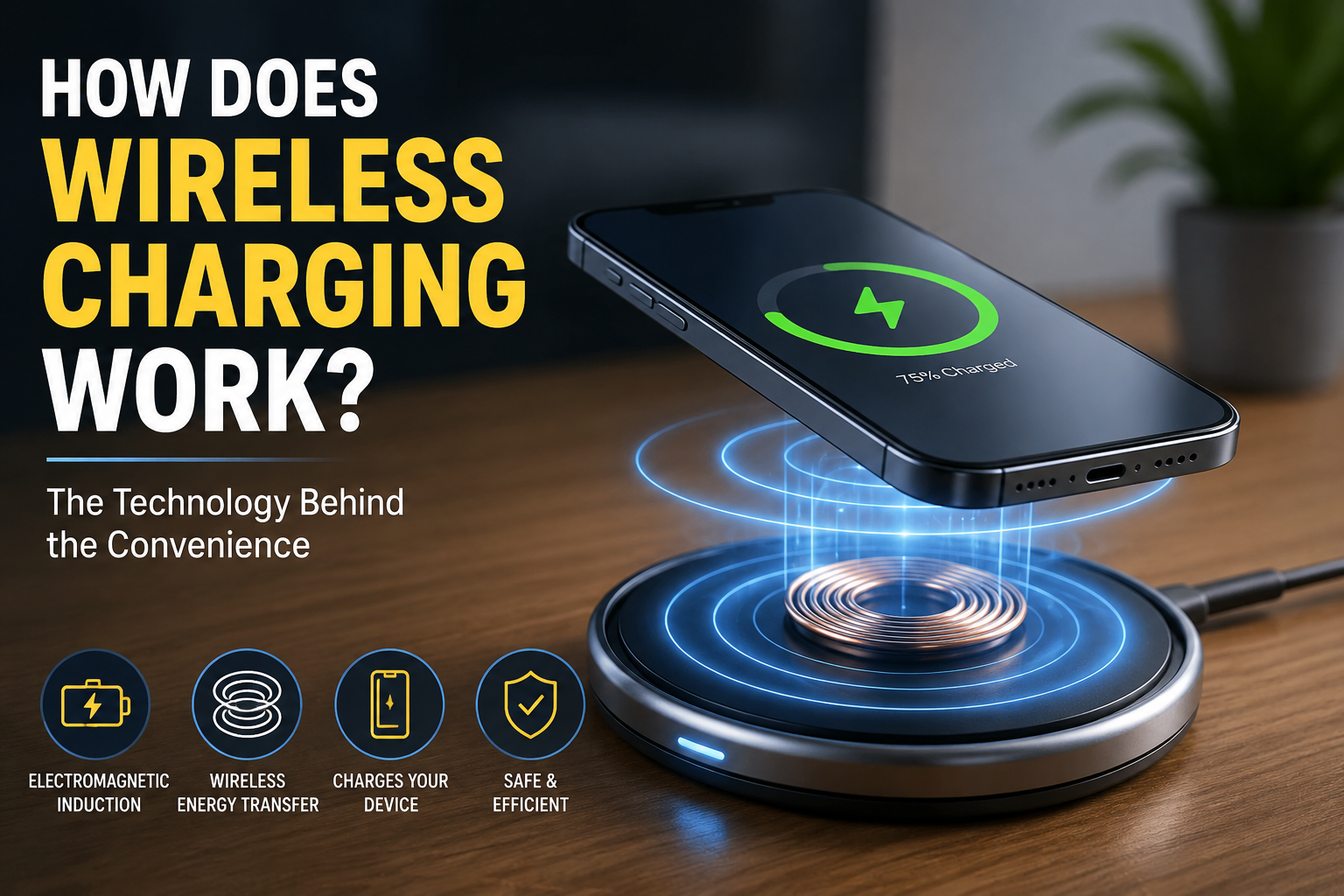
Placing your smartphone on a sleek charging pad and watching the battery icon illuminate without plugging in a single cable feels almost like magic. However, the technology behind this modern convenience relies on fundamental principles of physics discovered nearly two centuries ago. To understand how does wireless charging work, we must look into the invisible world of electromagnetic fields, copper coils, and intelligent power negotiation.
Today, wireless power transfer is standard in smartphones, smartwatches, wireless earbuds, and is rapidly expanding into medical devices and electric vehicles. In this guide, we will break down the underlying science of inductive power, how electricity travels through thin air safely, the role of standards like Qi and Qi2, and what the future holds for untethered energy.
The Core Physics: How Does Wireless Charging Work via Induction?
At its heart, modern wireless power relies on a process called electromagnetic induction. Discovered by scientist Michael Faraday in 1831, this phenomenon demonstrates that electricity can create magnetic fields, and magnetic fields can create electricity.
Instead of sending electrons directly through a copper wire into your phone's battery, wireless charging converts electrical energy into a magnetic field, transmits that field across a small distance, and then converts it back into usable electrical current inside your device.
Faraday’s Law of Induction
Faraday’s Law states that a changing magnetic field within a closed loop of wire induces an electromotive force (EMF) or voltage across the wire. When alternating current (AC) flows through a transmitter coil inside a charging pad, it generates a constantly fluctuating magnetic field directly above the pad.
The Role of Transmitter and Receiver Coils
For power transfer to occur, two tightly aligned components are required:
- Transmitter Coil: Located inside the charger, this coil connects to your wall outlet power source and generates the dynamic magnetic field.
- Receiver Coil: Embedded beneath the back glass or plastic of your smartphone or wearable, this coil catches the magnetic field lines and converts them back into an electric current.
Step-by-Step: How Electricity Moves Wirelessly to Your Phone
To better grasp how does wireless charging work during everyday use, we can break the process down into four synchronized steps that occur within milliseconds of placing a device on a charging base.
1. Handshake and Ping Signal
A wireless charging pad does not constantly emit high levels of energy. Instead, it sits in a low-power standby state, periodically broadcasting a small signal (a 'ping'). When a compatible device is placed on the pad, the receiver coil alters the magnetic field slightly. The charger detects this change and initiates a digital communication protocol (a 'handshake') to confirm compatibility and determine how much power the device can accept.
2. High-Frequency Magnetic Field Generation
Once validated, the charger sends high-frequency alternating current through its transmitter coil. This creates an oscillating magnetic field operating typically between 110 kHz and 205 kHz.
3. Current Induction and AC-to-DC Conversion
The oscillating magnetic field passes through the back cover of your device, passing directly across the receiver coil. This flux induces a corresponding alternating current inside the phone. Because smartphone lithium-ion batteries require direct current (DC) to charge safely, an internal rectifier circuit converts the AC electricity into DC energy.
Wireless Charging Standards: Qi, Qi2, and MagSafe
Interoperability is crucial for consumer electronics. Without universal standards, a charger from one manufacturer would not work with a phone from another. The dominant force in wireless power regulation is the Wireless Power Consortium (WPC).
The Original Qi Standard
Introduced in 2008, the Qi (pronounced 'chee') standard established universal protocols for inductive power transfer up to 15 watts. It ensures that any Qi-certified phone can safely draw power from any Qi-certified charging pad worldwide.
Qi2 and Magnetic Alignment
Building upon Apple's proprietary MagSafe technology, the WPC released the Qi2 standard. Qi2 incorporates a ring of internal magnets called the Magnetic Power Profile (MPP). This forces the transmitter and receiver coils into perfect physical alignment every time, reducing energy loss and thermal dissipation while increasing charging speed consistency.
Efficiency, Distance, and Thermal Management
While convenient, wireless power transfer faces distinct physical limitations compared to physical cable connections. Understanding these trade-offs clarifies why wireless speeds often lag behind traditional wired fast chargers.
Energy Efficiency Loss
Standard wired charging delivers roughly 85% to 95% of wall energy directly to the battery. In contrast, standard inductive wireless charging achieves between 60% and 80% efficiency. The remaining energy escapes primarily as heat during electromagnetic conversion.
Coil Distance and Alignment Impact
Electromagnetic field strength drops off drastically as distance increases (following the inverse-square law). Standard inductive chargers require the transmitter and receiver coils to be within 5 millimeters of each other. Thick metallic protective cases, credit card slots, or off-center alignment significantly degrade transfer efficiency and increase thermal build-up.
Safety Systems: Protecting Your Battery and Belongings
Pumping power through magnetic fields raises valid safety questions. Modern wireless chargers utilize sophisticated hardware safeguards to protect both your mobile hardware and nearby objects.
Foreign Object Detection (FOD)
If a metal coin, key, or paperclip is placed on an active wireless charging pad, the magnetic field will rapidly heat the metal through eddy currents. To prevent burns or fire hazards, Qi-certified chargers use Foreign Object Detection. The pad continuously monitors power loss; if energy is being drawn that does not match what the phone requested, the charger cuts power immediately.
Thermal Control and Smart Regulation
Heat is the enemy of battery longevity. Both the charging pad and the smartphone contain thermal sensors. If temperatures exceed safe thresholds (typically around 35°C to 40°C), the device commands the charger to reduce power or temporarily stop charging until cool.
Inductive vs. Resonance: The Next Phase of Wireless Power
Understanding how does wireless charging work requires recognizing that short-distance induction is only one method of wireless energy transfer.
Tightly Coupled Inductive Charging
Used in almost all current smartphones, tightly coupled induction offers high efficiency at extremely close ranges (0–5mm) but requires precise positioning.
Loosely Coupled Magnetic Resonance
Resonant charging tunes both transmitter and receiver coils to exact matching electromagnetic frequencies. This allows power transfer across larger distances (up to several centimeters) and enables a single transmitter pad to power multiple devices simultaneously without precise alignment.
Frequently Asked Questions
Does wireless charging degrade smartphone battery health faster?
Wireless charging itself does not harm battery health. However, excess heat generated during inefficient wireless charging can accelerate lithium-ion battery degradation over time. Using certified chargers with magnetic alignment (like Qi2 or MagSafe) minimizes excess thermal build-up.
Can wireless charging work through thick protective phone cases?
Most wireless chargers work reliably through standard plastic or rubber cases up to 3mm thick. However, cases containing metal plates, pop-sockets, ring holders, or thick wallet compartments will block magnetic fields and trigger Foreign Object Detection.
Why does my phone get warm when charging wirelessly?
Some energy is naturally lost as ambient heat during the double conversion process (electrical to magnetic energy, and back to electrical energy). Built-in sensors keep temperature within safe operating limits.
Will a wireless charger drain power when no phone is resting on it?
Modern Qi-certified chargers draw negligible standby power (often under 0.1 watts) because they remain in a low-power listening mode until a compatible receiver coil is detected.
Is wireless charging slower than plug-in cable charging?
Generally, yes. While modern fast wireless charging reaches 15W to 50W on specific devices, high-wattage wired chargers can deliver 65W to 120W+ with higher overall efficiency and less energy lost as heat.
Conclusion
Understanding how does wireless charging work reveals a sophisticated blend of 19th-century magnetic physics and cutting-edge 21st-century microelectronics. By transmitting power across magnetic fields between resonant copper coils, wireless charging offers a convenient, wear-free alternative to traditional charging ports.
As magnetic alignment innovations like Qi2 become the standard and long-range resonant power advances, wireless charging will continue to grow faster, cooler, and more efficient—paving the way toward a truly portless electronic ecosystem.
Related Reading
- fast charging protocols — Overview of mobile fast charging protocols and power standards
- lithium-ion battery degradation — How heat and charging cycles affect smartphone battery health
- Qi2 vs Qi wireless charging — Detailed comparison between Qi standard and new Qi2 magnetic charging
- USB-C power delivery — Guide to USB-C power delivery performance and cables