Guide · Jul 31, 2026
Why Do Batteries Lose Capacity Over Time?
Batteries lose capacity over time due to chemical degradation, SEI layer growth, electrode damage, and thermal stress. Discover the science of battery aging and how smart charging habits extend performance.
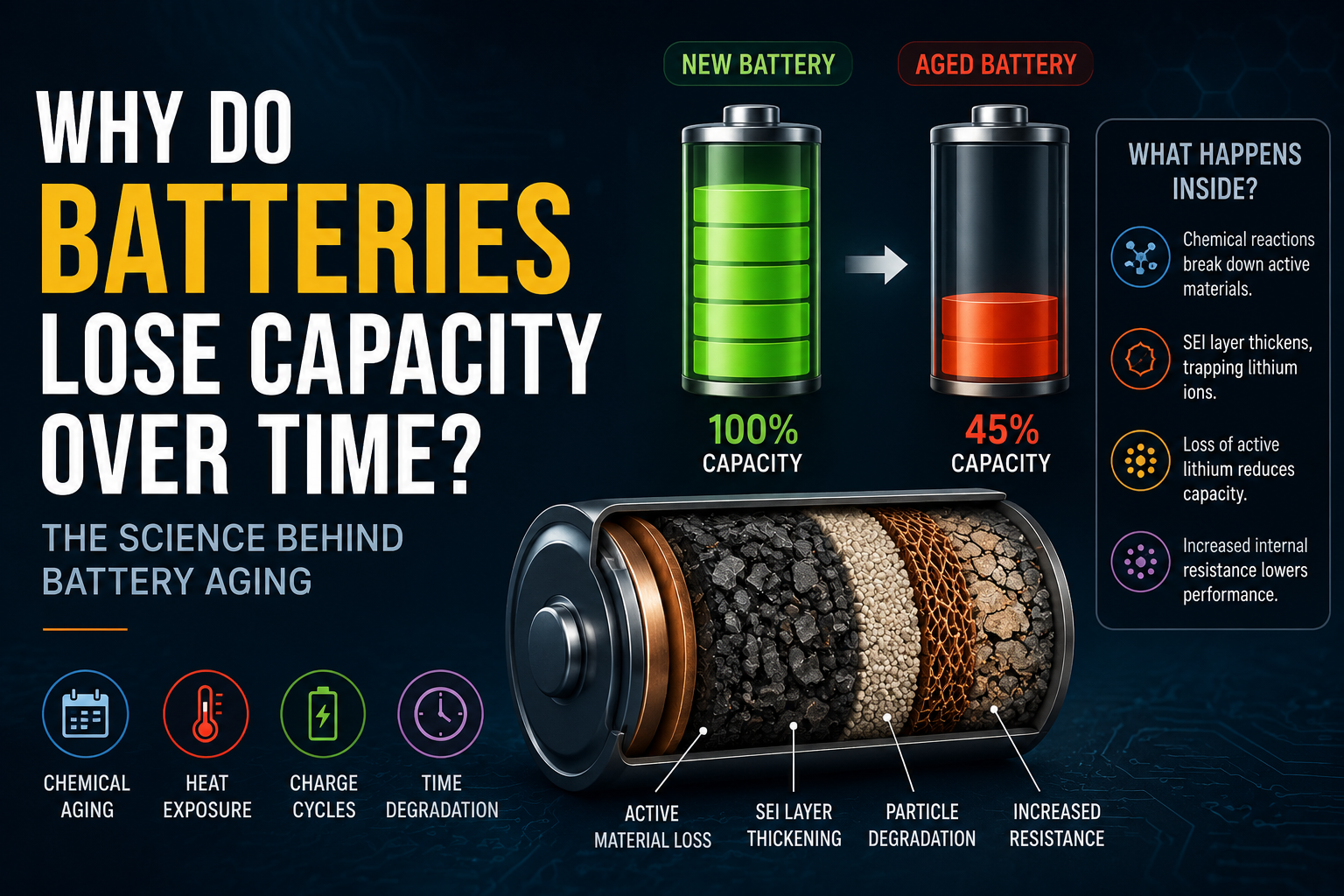
Whether powering smartphones, electric vehicles, laptops, or renewable energy storage, modern rechargeable batteries are essential to daily life. However, every battery user eventually notices a frustrating decline in performance: a device that once lasted an entire day gradually requires mid-afternoon recharging. To understand this performance slump, one must ask: why do batteries lose capacity over time?
Battery degradation is an inevitable physical and chemical process. Every time a battery goes through a charge and discharge cycle—and even while it sits idle on a shelf—microscopic changes alter its internal chemistry. In this comprehensive guide, we will break down the electrochemistry, thermal factors, and operational habits that drive battery capacity loss, along with actionable steps to extend the operational lifespan of your energy storage devices.
Understanding Why Do Batteries Lose Capacity Over Time: Electrochemistry Basics
At its core, a battery stores and releases energy by shuttling charge carriers—typically lithium ions in modern consumer electronics—between two electrodes: the anode (negative electrode) and the cathode (positive electrode), separated by an electrolyte medium. When you use your device, ions flow from anode to cathode, creating an electrical current. When you charge it, energy forces those ions back to the anode.
Over prolonged usage, this shuttling process is never 100% efficient. Microscopic secondary chemical reactions take place, permanently trapping active charge carriers and physically damaging internal components.
Electrochemical Degradation and Active Material Loss
During every charge cycle, a small percentage of charge-carrying ions become trapped in secondary chemical structures. Because fewer active ions remain available to transfer charge between the electrodes, the total electrical energy the cell can hold decreases. This loss of active material is one of the primary reasons why batteries lose capacity over time.
Solid Electrolyte Interphase (SEI) Layer Growth
On the battery's anode (often made of graphite), a protective passivation layer known as the Solid Electrolyte Interphase (SEI) forms during early charge cycles. While a stable SEI layer protects the anode from decomposing, continuous cycling causes this layer to thicken over time. As the SEI layer grows, it consumes usable ions and increases the cell's internal electrical resistance.
Chemical Mechanisms Explaining Why Batteries Lose Capacity Over Time
Beyond standard wear on the electrodes, specific unwanted chemical reactions occur deep inside the battery during regular operation. Understanding these chemical mechanisms provides deeper insight into cell aging.
Lithium Plating and Dendrite Formation
When a battery charges under suboptimal conditions—such as at high speeds or under cold temperatures—lithium ions cannot insert themselves into the anode graphite fast enough. Instead, metallic lithium accumulates on the surface of the anode, a phenomenon called lithium plating. Over time, these metallic deposits can sprout microscopic needle-like structures called dendrites, which lower cell capacity and create severe internal short-circuit risks.
Cathode Structural Micro-Cracking
The positive electrode (cathode) undergoes physical stress as ions move into and out of its crystal structure. This repeated expansion and contraction causes microscopic cracking in the cathode material. Micro-cracking detaches portions of the active material from the conductive network, reducing overall capacity and impeding electron flow.
Environmental Factors That Cause Batteries to Lose Capacity Over Time
Batteries are sensitive to environmental conditions. Storage environment and operational ambient temperatures dictate how quickly chemical degradation occurs within the cell casing.
Thermal Stress: The Impact of Excessive Heat
Heat acts as a catalyst for unwanted side reactions. Exposing a battery to high operating or ambient temperatures (above 35°C or 95°F) significantly accelerates electrolyte breakdown, speeds up SEI layer growth, and promotes transition metal dissolution from the cathode. Leaving a device in a hot car accelerates capacity loss far faster than normal daily use.
Freezing Temperatures and Internal Resistance
Cold temperatures cause the liquid electrolyte inside a battery to become sluggish and viscous. This slowdown increases internal resistance, forcing the battery to work harder to deliver power. Charging a battery under freezing conditions drastically increases the risk of severe lithium plating, causing permanent capacity drop.
How Usage Habits Accelerate Capacity Loss
While chemistry sets the baseline for battery aging, human usage patterns determine how rapidly that degradation unfolds in real-world applications.
Depth of Discharge (DoD) and High Voltage Stress
Depth of Discharge (DoD) measures how much of a battery's total capacity is used before recharging. Deeply discharging a cell to 0% and constantly topping it up to 100% subjects the internal chemical structures to high mechanical and electrical stress. Operating at extreme states of charge accelerates capacity drop compared to partial charge cycling.
Fast Charging and High C-Rates
Fast chargers supply current at high rates, generating substantial internal heat and electrical pressure. High charge rates increase localized stress within the electrodes, accelerating chemical degradation and shortening overall cycle life.
Calendar Aging vs. Cycle Aging
Battery capacity loss stems from two distinct processes: dynamic cycling and simple passage of time. Knowing the difference helps explain why stored batteries still lose charge capacity.
Understanding Calendar Aging
Calendar aging refers to capacity loss that occurs naturally over time, even when the battery is completely unused. Spontaneous chemical degradation and self-discharge occur continuously. Higher storage temperatures and keeping the cell at 100% state of charge exacerbate calendar aging.
Understanding Cycle Aging
Cycle aging is degradation directly tied to charging and discharging the battery during active use. Each complete charge-discharge cycle induces physical expansion, ionic transfer loss, and structural wear on the electrodes.
Practical Strategies to Slow Down Battery Capacity Loss
Although battery degradation cannot be stopped entirely, adoption of smart charging and storage habits can significantly slow down capacity loss and extend usable device life.
Adopt the 20-80% Rule for Everyday Charging
Avoid letting your device battery drop below 20% or sitting plugged in at 100% state of charge for extended periods. Keeping the state of charge between 20% and 80% reduces high-voltage stress and structural wear on electrodes, effectively prolonging cell health.
Manage Temperatures and Use Slow Charging
Keep electronics away from direct heat sources, avoiding charging under thick blankets or inside hot environments. When fast charging is unnecessary—such as overnight charging—opt for lower wattage charging to minimize thermal and mechanical strain.
Frequently Asked Questions
Why do batteries lose capacity over time even when not in use?
Batteries degrade even when unused due to calendar aging. Parasitic chemical reactions between the electrolyte and electrodes continue at a microscopic level, gradually consuming active lithium ions and reducing usable capacity over time.
Does fast charging permanent ruin battery capacity?
Fast charging generates extra heat and electrical strain, which speeds up solid electrolyte interphase (SEI) growth and lithium plating. While it does not ruin a battery instantly, frequent fast charging accelerates long-term capacity degradation compared to slow charging.
What is the ideal percentage range to maintain battery health?
Maintaining your battery's charge level between 20% and 80% is ideal for lithium-ion chemistries. This range minimizes electrode mechanical strain and voltage stress, slowing down capacity degradation.
Can lost battery capacity ever be restored?
No, chemical capacity loss in modern rechargeable batteries is irreversible. However, recalibrating the device management system (by discharging to critical level and charging uninterrupted to 100%) can fix inaccurate percentage displays.
How many cycles does a typical lithium-ion battery last?
A standard consumer lithium-ion battery maintains approximately 80% of its initial capacity for about 300 to 500 complete charge cycles, whereas specialized chemistries like Lithium Iron Phosphate (LiFePO4) can last between 2,000 and 5,000 cycles.
Does leaving a phone plugged in overnight damage capacity?
Modern electronics feature protection circuits to prevent overcharging. However, leaving a phone at 100% charge overnight maintains continuous high voltage and mild thermal exposure, which slightly accelerates calendar aging over long periods.
Conclusion
Understanding why do batteries lose capacity over time helps users take control of their device longevity. Battery degradation is driven by fundamental electrochemical shifts, including SEI layer thickening, active ion trapping, thermal stress, and electrode structural micro-cracking. By practicing smart charging habits—such as avoiding temperature extremes, keeping charge levels between 20% and 80%, and minimizing constant fast charging—you can significantly slow capacity loss and maximize the operational life of your battery-powered electronics.
Related Reading
- lithium-ion battery care tips — Comprehensive guide to lithium-ion battery maintenance and longevity
- understanding battery cycle count — Explaining how charge cycles work and how to track them
- fast charging impact on battery life — Deep dive into fast charging technology and cell health
- preventing battery swelling — Causes, risks, and prevention of swollen lithium-ion cells