Guide · Aug 12, 2026
Why Do Some Chargers Charge Faster Than Others?
Discover the technical reasons why do some chargers charge faster than others, from power delivery protocols and wattage output to cable limits and battery chemistry.
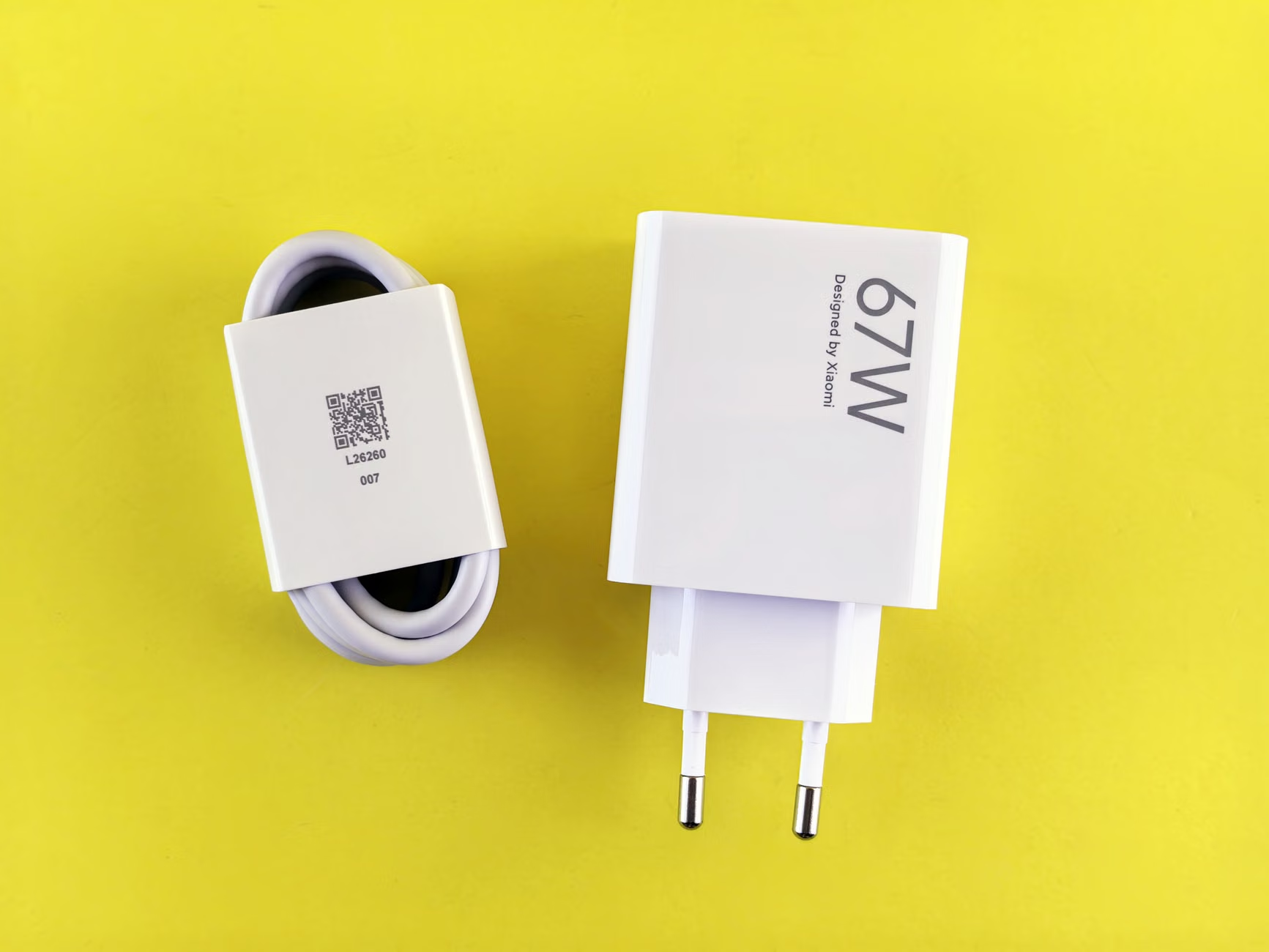
Plugging in your smartphone, laptop, or tablet and watching the battery percentage jump rapidly feels like pure convenience, but the engineering behind it is surprisingly complex. You may have noticed that using one wall adapter fills your device in 30 minutes, while another plugged into the same outlet takes hours. So, why do some chargers charge faster than others?
The short answer comes down to electrical output power, intelligent communication between the charger and device, hardware quality, and heat management. To truly understand why chargers charge faster, we need to look beyond the plastic casing and explore how volts, amps, fast-charging standards, and internal power management systems work together.
The Science of Electrical Power: Why Do Some Chargers Charge Faster?
At its core, battery charging is governed by basic physics. The primary reason why do some chargers charge faster comes down to the amount of power, measured in watts, the power adapter can push to the target device.
Understanding Volts, Amps, and Watts
To understand fast charging, think of electricity flowing through a charger like water flowing through a pipe:
- Volts (Voltage/V): The pressure pushing electrical energy through the circuit.
- Amps (Current/A): The volume or rate of electrical flow moving through the line.
- Watts (Power/W): The total amount of energy delivered per second, calculated as Watts = Volts × Amps.
An old standard USB wall adapter typically outputs 5 Volts at 1 Amp, yielding 5 Watts of total power. In contrast, modern fast chargers can push 9V at 3A (27W) or even 20V at 5A (100W). Higher wattage directly translates to faster energy transfer into your device's battery.
Power Ratings and Max Output Capacity
Every charger lists its maximum rated power output on its technical label. A charger rated for 5W simply lacks the physical capability to deliver energy as quickly as a 65W or 120W adapter, regardless of what device you plug into it.
Device Acceptance Limits: Why Wattage Isn't the Only Factor
While a charger's maximum power rating sets the upper speed limit, your electronic device plays an equally crucial role in determining overall charging speed. Chargers do not force power into a battery; rather, the device pulls power from the charger.
The Role of the Battery Management System (BMS)
Inside every smartphone, laptop, and tablet is a specialized microchip called the Battery Management System (BMS). The BMS acts as a security guard for your battery. When you connect a high-wattage charger—such as a 100W laptop charger—to a smartphone that only accepts a maximum of 25W, the BMS communicates with the charger and restricts the power drawn to 25W to prevent overheating, swelling, or internal damage.
The Charging Curve and Thermal Throttling
Lithium-ion batteries do not charge at a constant speed from 0% to 100%. Instead, they follow a distinct charging curve:
- Constant Current (Fast Phase): From 0% to roughly 50-80%, the device accepts maximum power, resulting in rapid charging.
- Constant Voltage (Slowing Phase): Beyond 80%, the BMS gradually tapers down power input to protect internal chemistry and maintain stability.
Additionally, if your device gets too hot due to heavy usage or high ambient temperatures, the BMS will throttle charging speeds to lower internal heat.
Fast Charging Protocols: How Software Dictates Why Chargers Charge Faster
Power transfer is not a passive process. For high speeds to occur, the charger and device must speak the exact same digital software protocol to negotiate dynamic power levels safely.
USB Power Delivery (USB-PD) and Programmable Power Supply (PPS)
USB Power Delivery (USB-PD) is the industry-standard protocol used across modern Apple, Google, and laptop ecosystems. USB-PD allows devices and chargers to negotiate higher voltages dynamically. An advanced variant, PPS (Programmable Power Supply), enables minute real-time adjustments to voltage and current, reducing heat generation and maximizing charging efficiency.
Proprietary Fast Charging Standards
Many smartphone manufacturers design custom fast-charging systems to achieve extremely high speeds. While standard USB-PD might top out at 20W-45W for mobile devices, proprietary protocols—such as Qualcomm Quick Charge, OnePlus Warp Charge, or Xiaomi HyperCharge—use custom handshakes to deliver up to 120W or 200W using specialized hardware.
How Cables Determine Why Some Chargers Charge Faster Than Expected
Even if you pair a high-output wall brick with a device capable of ultra-fast charging, the connecting cable can easily create a hidden bottleneck in the power pipeline.
Wire Resistance and Gauge Sizes
Thinner, low-quality charging cables use internal copper wires with high electrical resistance. As energy flows through a high-resistance wire, a portion of the power is wasted as heat rather than reaching your battery. High-power cables use thicker internal wire gauges (lower AWG numbers) to minimize resistance and deliver maximum current efficiently.
E-Marker Chips in USB-C Cables
Cables capable of carrying high current (such as 5A for power delivery over 60W) contain built-in microcontrollers called Electronically Marked (E-Marker) chips. These chips identify the cable's safety parameters to both the charger and the connected device. If you use a basic USB-C cable without an E-Marker chip, the charger will cap its output at 60W (3A) for safety reasons.
GaN vs. Silicon Technology: The Hardware Evolution of Speed
In recent years, charger manufacturing underwent a massive technological shift, explaining why newer, smaller power bricks charge significantly faster than older, bulky adapters.
What Is Gallium Nitride (GaN)?
Traditionally, wall chargers relied on silicon-based semiconductors. However, modern fast chargers use Gallium Nitride (GaN). GaN is a semiconductor material capable of conducting higher electrical currents and switching frequencies with dramatically higher energy efficiency than silicon.
Thermal Efficiency and Compact Design
Because GaN components lose much less energy as wasted heat, components can be packed much closer together. This allows manufacturers to build 65W or 100W GaN chargers that are half the physical size of traditional silicon-based laptop bricks without overheating.
External Factors That Affect Daily Charging Speeds
Beyond technical specifications, real-world environmental factors and usage habits play a direct role in how fast your charger performs day to day.
Ambient Temperature and Device Heating
Lithium-ion batteries perform best within a narrow temperature range (roughly 16°C to 22°C or 60°F to 72°F). Charging in direct sunlight, inside a warm vehicle, or under a pillow causes the thermal sensors inside the phone to restrict charging speed automatically to prevent thermal runaway.
Active Screen Usage While Charging
Using your device for intensive tasks—such as gaming, video streaming, or GPS navigation—while plugged in splits the incoming electrical energy between running the hardware screen/processor and filling the battery, causing noticeable slowdowns in charge progression.
Frequently Asked Questions
Can using a faster charger damage my phone battery?
No. Modern devices feature built-in Battery Management Systems (BMS) that actively regulate power input. Your phone will only draw the maximum amount of power it was safely designed to accept, even if connected to a 100W or higher charger.
Does cable length affect charging speed?
Yes. Longer charging cables have higher electrical resistance than shorter ones. A very long or poorly constructed cable can cause a voltage drop, reducing overall power efficiency and slowing down charging speeds.
What does GaN mean on a charger?
GaN stands for Gallium Nitride, a modern semiconductor material used in place of traditional silicon. GaN chargers are more energy-efficient, generate less heat, and deliver higher power outputs in significantly smaller form factors.
Why does my phone charge fast at first and slow down after 80%?
This is by design to protect battery health. Charging from 0% to 80% uses a constant fast current. After 80%, the charger switches to a lower trickle-charge phase to protect the internal battery chemistry from stress and overheating.
Why does my wireless charger charge slower than a wired charger?
Wireless charging transfers energy through electromagnetic induction, which generates significantly more heat and incurs higher energy loss compared to direct electrical contact through a wire. Heat forces the system to run at reduced speeds.
How do I know if my charger supports fast charging?
Check the power output specifications printed on the wall brick. Look for wattage output ratings higher than 15W, higher voltage options (like 9V or 12V), or labeled protocol support such as USB Power Delivery (USB-PD) or Quick Charge (QC).
Conclusion
Understanding why do some chargers charge faster than others ultimately comes down to an ecosystem of hardware and software working in tandem. From the peak wattage capacity of the wall brick and the internal resistance of the cable to battery chemistry curves and protocol handshakes like USB Power Delivery, every component plays a role.
To get the maximum charging performance out of your devices, pair high-quality GaN wall adapters with certified, high-wattage cables that match the exact power input capabilities of your smartphone or laptop.
Related Reading
- understanding USB Power Delivery protocols — USB Power Delivery vs Quick Charge protocols explained
- GaN charger technology benefits — Gallium Nitride vs traditional silicon chargers guide
- maximizing lithium-ion battery health — How to extend phone battery life and manage charging cycles
- choosing high-wattage USB-C cables — How to choose the right USB-C cable for fast charging